3/02/26
Case study – Daidore Corporation
Daidore Corporation is a Japanese manufacturing company specializing in the production of industrial components, with a strong focus on agile product development and process optimization. Operating in an increasingly competitive and fast-evolving industrial environment, Daidore has positioned itself early on as an innovation-driven manufacturer, adopting advanced production technologies to remain competitive.
Faced with growing pressure to shorten development cycles while maintaining high part quality, the company initiated a strategic review of its manufacturing processes.
The traditional manufacturing methods used by Daidore—particularly casting processes and the production of components without existing molds or design drawings—were becoming increasingly restrictive:
In this context, Daidore was looking for a solution capable of:
Metal additive manufacturing quickly emerged as a strategic lever, and its implementation was defined as a key corporate initiative.
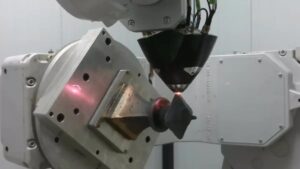
After evaluating several metal additive manufacturing technologies—including powder bed fusion (LPBF) and binder jetting—Daidore selected Meltio’s Wire-Laser Directed Energy Deposition (DED) technology, implemented through the Meltio Robot Cell.
This decision was driven by a unique combination of cost efficiency, flexibility, and scalability.
Key decision factors:
Material cost efficiency
Meltio’s wire-based technology uses standard welding wire, reducing material costs by up to 80–90% compared to powder-based systems.
Advanced geometrical freedom
The combination of a 6-axis robotic arm and a dual-axis rotating build table enables the production of complex and organic geometries while significantly reducing the need for support structures.
Large build volume
The Meltio Robot Cell offers a working envelope of 2 × 1 × 1 m, making it well suited for large parts or batch production of multiple components.
Simplified infrastructure requirements
Unlike powder-based additive manufacturing systems, Meltio solutions require no ATEX facilities, sintering, or debinding equipment, simplifying industrial integration and reducing operational risk.
Multi-material capabilities
The ability to deposit up to two different metal materials within the same part enables advanced functional and hybrid applications.
Since implementing the Meltio Robot Cell, Daidore has deployed the technology across a wide range of manufacturing applications:
Replacement of cast parts
On-demand production of metal components without tooling, dramatically reducing lead times and costs.
New product development
Rapid production of functional prototypes to support R&D activities and accelerate time to market.
Tool-less part manufacturing
Production of metal parts without existing molds or drawings, using reverse engineering or design-from-scratch workflows.
Discontinued part reproduction
Re-manufacturing of legacy components for which tooling is no longer available or has become obsolete.
Machining jig production
In-house design and manufacturing of custom jigs to support production and quality assurance processes.
The adoption of Meltio technology has enabled Daidore to fundamentally transform its approach to metal production:
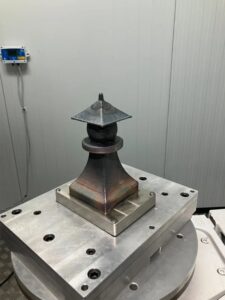
With Meltio Wire-Laser DED, Daidore now benefits from a flexible and industrially mature manufacturing solution, capable of rapidly responding to customer needs while unlocking new business opportunities.
 FR
FR