1/04/26
Understanding properties, printing requirements, and industrial applications of PAEK materials for large-format additive manufacturing
High-temperature polymers such as PEEK, PEKK, and other members of the PAEK family have become essential in advanced additive manufacturing. Their ability to withstand extreme temperatures, heavy mechanical loads, and aggressive chemical environments makes them ideal solutions for applications where conventional plastics fall short.
As more engineers explore metal replacement and lightweighting strategies, mastering these engineering-grade materials has become essential. This guide breaks down their properties, printing requirements, and application areas to help you make informed decisions.
High-temperature polymers constitute a class of engineering thermoplastics designed to perform in environments where heat, mechanical stress, and chemical exposure would quickly degrade standard materials. They are distinguished by their elevated glass transition temperatures, high melting points, and exceptional thermal stability.
Many polymers in this family, notably PEEK and PEKK from the PAEK family, maintain adequate mechanical strength at temperatures exceeding 250°C and resist deformation well above the limits of common plastics like nylon, ABS, or PC.
These materials enable metal replacement in demanding applications while reducing weight, improving corrosion resistance, and enabling more complex part geometries. Their chemical resistance makes them suitable for harsh industrial environments, and their insulation properties are valuable for electrical and high-voltage components.
In fields such as aerospace, medical devices, automotive, and energy, these polymers unlock new design possibilities by combining durability, heat performance, and processability in a way that few materials can match.
High-temperature polymers are classified as engineering-grade because they maintain performance where conventional thermoplastics fail. Although their properties differ from metals, their mechanical, thermal, and chemical characteristics place them in the same decision space as metals for many demanding applications.
These polymers exhibit very high HDT values, often above 200°C, allowing them to retain shape and strength under continuous thermal load. This stability is essential for under-hood automotive components, aerospace ducts, and electrical housings.
Materials such as PEEK and PEKK deliver tensile and flexural strength that far exceeds commodity plastics. This level of stiffness and load capacity enables them to replace aluminum in brackets, fixtures, and structural components.
These high-temperature materials resist crack propagation and cyclic loading, making them suitable for moving parts, vibration-prone assemblies, and long-term industrial use. Their fatigue resistance explains their adoption in aerospace interiors and functional parts.
PAEK polymers, PEKK, PEEK, and PPSU remain stable when exposed to fuels, solvents, disinfectants, and industrial chemicals. This broad chemical compatibility expands their use into energy, oil and gas, laboratory equipment, and sterilization environments.
The surface durability of these polymers is significantly higher than standard plastics. They resist wear from friction, sliding contact, and particulate exposure, supporting their use in bearings, gears, and mechanical housings.
Many high-temperature polymers tolerate repeated steam sterilization, gamma radiation, or chemical disinfectants. This makes them ideal for medical applications and any component that must undergo strict cleaning cycles.
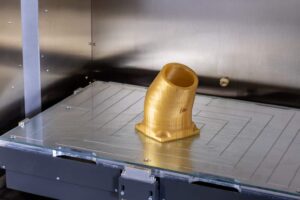
PEEK is one of the highest-performing polymers in the PAEK family. It typically operates at continuous service temperatures around 240°C and maintains mechanical strength even in demanding environments. Engineers choose PEEK for its combination of high tensile strength, exceptional chemical resistance, and stability at elevated temperatures.
PEEK appears in real production parts such as bearings, pump housings, sealing components, electrical connectors, and lightweight structural brackets in aerospace. It excels in environments where metal replacement is a priority, but stiffness and reliability cannot be compromised.
Printing PEEK can be challenging due to its semi-crystalline structure. It requires strict thermal control, including a high-temperature extruder, a consistently heated chamber, and proper annealing to avoid warping or poor layer adhesion.
PEKK belongs to the same PAEK family as PEEK but behaves differently during printing. The key distinction is its slower crystallization rate. This makes PEKK more forgiving inside the build chamber and better suited for complex geometries or parts with varying wall thicknesses. PEKK also offers excellent chemical resistance and strong mechanical properties that closely match PEEK.
Engineers choose PEKK for aerospace ducts, lightweight brackets, high-performance industrial housings, and parts that benefit from a more controlled crystallization process. Its improved printability makes it a popular alternative where dimensional accuracy is critical.
PPSU is known for its hydrolytic stability and excellent resistance to repeated steam sterilization. It withstands aggressive cleaning agents, disinfectants, and high-moisture environments, which explains its widespread adoption in medical and laboratory sectors. PPSU performs well in fluid handling components, sterilization trays, and any part that must endure long-term exposure to moisture and heat.
Aerospace teams also rely on PPSU for interior components because it combines flame resistance with durability and ease of processing.
Ultem, or PEI, is a more cost-effective high-temperature polymer that retains impressive mechanical and thermal performance. While not as strong as PEEK or PEKK, it offers reliable stiffness, good electrical insulation, and heat resistance suitable for demanding production environments.
This makes Ultem ideal for jigs, fixtures, production tooling, and large-format parts where cost efficiency matters as much as performance. Its balance of printability and heat resistance has made it one of the most widely adopted engineering-grade thermoplastics.
Composite variants such as CF PEEK and CF PEKK incorporate carbon fiber reinforcement to significantly increase stiffness and tensile strength. These composites outperform standard polymers when maximum rigidity, dimensional stability, and lightweighting are required. They are often used in aerospace brackets, high-load mechanical parts, and structural components where metal replacement is the goal.
Although composites offer superior strength, the added fibers can make printing more demanding due to abrasive wear on nozzles and the need for precise temperature control.
High-temperature polymers demand far more control over the printing environment than standard materials. Their semi-crystalline structures, elevated melting points, and sensitivity to thermal fluctuations mean that print success depends on achieving a fully stable thermal envelope.
To process materials like PEEK, PEKK, and other PAEK polymers, the extruder must reach temperatures in the range of 350 to 450°C. These polymers do not flow correctly at lower temperatures, and insufficient melt energy leads to poor layer adhesion, warping, and incomplete crystallization.
A hardened nozzle is essential because materials such as CF PEEK and CF PEKK are highly abrasive. Standard brass nozzles wear quickly and degrade print accuracy. A stable melt flow is also important for semi-crystalline polymers, as fluctuations introduce internal stresses and increase the risk of warping or delamination.
A controlled, high-temperature chamber in the range of 100 to 180°C is vital for printing PEEK, PEKK, and similar materials. The heated chamber prevents steep temperature gradients around the printed part and maintains an even environment for proper crystallization.
Without chamber heat, parts cool too quickly, which causes internal stress, curling, and cracks. A warm chamber allows the polymer chains to orient correctly and solidify in a stable structure that maintains dimensional accuracy.
The build plate must also operate at elevated temperatures, typically between 120 and 160°C. This helps the first layers bond securely and reduces the risk of warping across large surfaces. Engineering-grade polymers contract as they cool, so preventing early shrinkage is essential.
Effective adhesion methods include PEI sheets, Garolite surfaces, high-temperature adhesives, and textured build plates. The correct choice depends on the polymer and the geometry of the part, but all aim to maximize first-layer stability.
High-temperature polymers often require post-processing to achieve optimal performance. Annealing is one of the most important steps because it allows further crystallization to occur after printing. Proper annealing increases strength, improves thermal stability, and reduces internal stress.
Support removal may also require elevated temperatures or solvent assistance, depending on the material. Finally, dimensional stabilization is important for applications that demand tight tolerances. This may include controlled cooling cycles or post-machining.
High-temperature polymers are used across many advanced sectors because they combine strength, stability, and chemical resistance in environments where traditional plastics fail.
Aerospace teams use PEEK, PEKK, and composite variants to replace metal brackets, ducts, and interior components. These polymers provide significant weight savings, which translate directly into fuel efficiency. Their ability to withstand vibration, heat, and long-term mechanical stress makes them ideal for structural and semi-structural parts.
Medical applications benefit from materials like PPSU and PEEK because they tolerate repeated sterilization cycles without degrading. PPSU is used for trays, handles, and fluid handling devices, while PEEK is selected for implantable components due to its biocompatibility, strength, and resistance to disinfectants.
Automotive engineers use PEEK and PEKK for under-hood components that must endure high temperatures, fuel exposure, and mechanical stress. These materials also support the production of durable electrical connectors and sensor housings that require thermal stability and long-term chemical resistance.
In the energy and industrial sectors, high-temperature polymers are chosen for chemically resistant housings, pump components, and parts that operate in harsh processing environments. Their ability to withstand corrosive fluids, heat, and high mechanical loads makes them suitable for oil and gas equipment, chemical processing lines, and industrial machinery.
Manufacturing teams rely on polymers such as PEI, PEEK, and composite grades for high-temperature jigs, fixtures, and end-of-arm tooling. These materials maintain dimensional stability under heat, provide strong stiffness, and allow rapid iteration of production tools at a lower cost than metal.
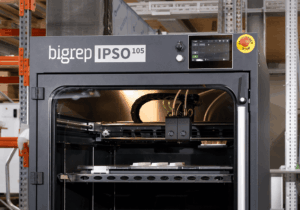
BigRep supports the full lifecycle of high-temperature polymer printing by providing tools, expertise, and application guidance that help teams succeed with materials such as PEEK, PEKK, PPSU, and PEI.
Large-format capability allows engineers to produce sizable functional components that would be difficult or impossible to manufacture on smaller systems. This is particularly valuable for tooling, fixtures, and industrial production parts that benefit from the dimensional space BigRep systems provide.
Beyond hardware, BigRep offers application development support to help teams identify the right material and print strategy for each use case. With extensive experience working with engineering-grade polymers, BigRep consultants understand the thermal, mechanical, and chemical considerations that influence part quality.
High-temperature polymers such as PEEK, PEKK, PPSU, and PEI continue to grow in importance because they allow engineers to achieve metal-level performance with lower weight, lower cost, and greater design flexibility. Their adoption spans aerospace, medical, automotive, industrial, and manufacturing sectors, where durability, heat performance, and chemical resistance are critical.
Successful printing of these materials depends on choosing the right polymer, understanding its behavior, and maintaining a controlled thermal environment across the extruder, chamber, and build plate.
Material selection and printing conditions determine whether a part reaches its full mechanical potential. Engineers who match the right high-temperature polymer with the correct print strategy can unlock new opportunities in lightweighting, tooling, and production applications.
This article is based on technical content published by BigRep. For more information on large-format 3D printing solutions and high-temperature polymers, contact Multistation experts.
 FR
FR